He goes on to note his train of thought as he sits, book on knee, before the fire: he reads a line of his philosopher, decided that the fire needs wood, puts it on, reads another line, suddenly recalls a verse by Lermontov; he yawns, paces over to the windo, hums a sonata, watches the falling snow for 10 minutes, imagines himself a cabinet minister, then returns to his Fichte, and for five minutes stares smiling into the fire. “Oh, the joy of leisured, studious solitude!”
Araham Yarmolinsky, Turgenev, the man, his art, and his age
“There are interests higher than poetic interests”, says Turgenev, “a moment of self-awareness and criticism is as essential in the development of a nation’s life as it is in the life of an individual person”.
Certainly true, yet, the poetic interest — the kind of puzzled wonderment brought about by a beautifully structured sentence — has its place and worth. Consider this sentence, one of the last in Leonardo da Vinci’s notebooks, the year is perhaps 1517, he may already have suffered his stroke, there are at most two inconsequential, crippled years to go:
“St. Andrew’s night. I am through with squaring the circle, and this is the end of light, and of the night, and of the paper I was working on.”
Ross King adds:
“The candle gutters, dawn light peeps through the shutters, and Leonardo, in nightcap and spectacles, blearily casts aside his pen.”
There are other interests, certainly, but what is wrong with stopping to take in the beauty of this reflection?
Good old Turgenev stimulates no interest today. There has been no book or study published about him in English in thirty years. Compare him to Tolstoy and Dostoevsky who each generate, it seems, at least two English books a year.
Sensible, sceptical, progressive, liberal, rational, in his lifetime Turgenev quarrelled with both those writers; he found Tolstoy’s religious enthusiasms unbearable; Turgenev freed his peasants not because it was holy to do so, or because he believed in some profound mystical and spiritual and soul-saving light buried deep in the Russian peasant soul, or because he wanted to live like a simple Russian peasant, but because it was the rational and the humane thing to do. And he found Dostoevsky’s reactionary conservatism repugnant. Given his temperament, he probably also found Dostoevsky’s novels sick.
Small wonder that Western scholars aren’t interested in Turgenev. Rational cultured minds are maybe admirable and pleasant to spend time with but aren’t exciting and, as a result, make poor-selling copy. Far better madmen, religious freaks, and political fantasists.
This man, one of Russia’s most admirable and sensible thinkers ever, isn’t popular in Russia, either, mainly because he refused to believe in some inherent Russian superiority. A great admirer of European art and classical music, he emigrated to Switzerland and then France. And in his novels put his views on Russian culture of the times plainly:
“Why, there’s a (Russian) gentleman disporting himself here, who imagines he’s a musical genius. “I have done nothing, of course,” he’ll tell you. “I’m a cipher, because I’ve had no training, but I’ve incomparably more melody and more ideas in me than in Meyerbeer.” In the first place, I say: why have you had no training? and secondly, that, not to talk of Meyerbeer, the humblest German flute-player, modestly blowing his part in the humblest German orchestra, has twenty times as many ideas as all our untaught geniuses; only the flute-player keeps his ideas to himself, and doesn’t trot them out with a flourish in the land of Mozarts and Haydns; while our friend the rough diamond has only to strum some little waltz or song, and at once you see him with his hands in his trouser pocket and a sneer of contempt on his lips: I’m a genius, he says. And in painting it’s just the same, and in everything else. Oh, these natural geniuses, how I hate them!
As if every one didn’t know that it’s only where there’s no real science fully assimilated, and no real art, that there’s this flaunting affectation of them. Surely it’s time to have done with this flaunting, this vulgar twaddle, together with all hackneyed phrases such as “no one ever dies of hunger in Russia,” “nowhere is there such fast travelling as in Russia,” “we Russians could bury all our enemies under our hats.” I’m for ever hearing of the richness of the Russian nature, their unerring instinct, and of Kulibin…. But what is this richness, after all, gentlemen? Half-awakened mutterings or else half-animal sagacity. Instinct, indeed! A fine boast. Take an ant in a forest and set it down a mile from its ant-hill, it will find its way home; man can do nothing like it; but what of it? do you suppose he’s inferior to the ant? Instinct, be it ever so unerring, is unworthy of man; sense, simple, straightforward, common sense—that’s our heritage, our pride; sense won’t perform any such tricks, but it’s that that everything rests upon. As for Kulibin, who without any knowledge of mechanics succeeded in making some very bad watches, why, I’d have those watches set up in the pillory, and say: see, good people, this is the way not to do it. Kulibin’s not to blame for it, but his work’s rubbish. To admire Telushkin’s boldness and cleverness because he climbed on to the Admiralty spire is well enough; why not admire him? But there’s no need to shout that he’s made the German architects look foolish, that they’re no good, except at making money…. He’s not made them look foolish in the least; they had to put a scaffolding round the spire afterwards, and repair it in the usual way. For mercy’s sake, never encourage the idea in Russia that anything can be done without training. No; you may have the brain of a Solomon, but you must study, study from the A B C. Or else hold your tongue, and sit still, and be humble! Phoo! it makes one hot all over!’
Potugin took off his hat and began fanning himself with his handkerchief.
‘Russian art,’ he began again. ‘Russian art, indeed!… Russian impudence and conceit, I know, and Russian feebleness too, but Russian art, begging your pardon, I’ve never come across. For twenty years on end they’ve been doing homage to that bloated nonentity Bryullov, and fancying that we have founded a school of our own, and even that it will be better than all others…. Russian art, ha, ha, ha! ho, ho!’ ‘Excuse me, though, Sozont Ivanitch,’ remarked Litvinov, ‘would you refuse to recognise Glinka too, then?’
Potugin scratched his head.
‘The exception, you know, only proves the rule, but even in that instance we could not dispense with bragging. If we’d said, for example, that Glinka was really a remarkable musician, who was only prevented by circumstances—outer and inner—from becoming the founder of the Russian opera, none would have disputed it; but no, that was too much to expect! They must at once raise him to the dignity of commander-in-chief, of grand-marshal, in the musical world, and disparage other nations while they were about it; they have nothing to compare with him, they declare, then quote you some marvellous home-bred genius whose compositions are nothing but a poor imitation of second-rate foreign composers, yes, second-rate ones, for they’re the easiest to imitate. Nothing to compare with him? Oh, poor benighted barbarians, for whom standards in art are non-existent, and artists are something of the same species as the strong man Rappo: there’s a foreign prodigy, they say, can lift fifteen stone in one hand, but our man-154- can lift thirty! Nothing to compare with us, indeed! I will venture to tell you some thing I remember, and can’t get out of my head. Last spring I visited the Crystal Palace near London; in that Palace, as you’re aware, there’s a sort of exhibition of everything that has been devised by the ingenuity of man—an encyclopædia of humanity one might call it. Well, I walked to and fro among the machines and implements and statues of great men; and all the while I thought, if it were decreed that some nation or other should disappear from the face of the earth, and with it everything that nation had invented, should disappear from the Crystal Palace, our dear mother, Holy Russia, could go and hide herself in the lower regions, without disarranging a single nail in the place: everything might remain undisturbed where it is; for even the samovar, the woven bast shoes, the yoke-bridle, and the knout—these are our famous products—were not invented by us. One could not carry out the same experiment on the Sandwich islanders; those islanders have made some peculiar canoes and javelins of their own; their absence would be noticed by visitors. It’s a libel! it’s too severe, you say perhaps…. But I say, first, I don’t know how to roar like any sucking dove; and secondly, it’s plain that it’s not only the devil no one dares to look-155- straight in the face, for no one dares to look straight at himself, and it’s not only children who like being soothed to sleep. Our older inventions came to us from the East, our later ones we’ve borrowed, and half spoiled, from the West, while we still persist in talking about the independence of Russian art! Some bold spirits have even discovered an original Russian science; twice two makes four with us as elsewhere, but the result’s obtained more ingeniously, it appears.’
Perhaps recognizing the truth of these sentiments, Russians did not take kindly to such words. And despite the fact that a century and a half later, Russia can boast a truly significant contribution to Western classical music (Stravinsky, Prokofiev, Shoskakovich), Russians still feel small and uncouth and uncultured compared to their Western neighbors and such sentiments still rile.
As the Russian proverb has it, the truth pokes in the eye.
I love reading like this: books that delight with plentiful obscure detail and anecdote and require one to constantly look things up; reading that leads to other reading, often in unexpected directions. Who would have expected that a book about Leonardo da Vinci would have led me to Marie Bonaparte, a 20th century psychoanalyst?
In 1907, when she was 25, her father, a prince from the lateral, that is to say, non-dynastic branch of the Bonaparte family, himself an avid botanist,
arranged Maria’s marriage to Prince George of Greece and Denmark, the second son of King George I of the Hellenes. Prince George was 13 years older than his bride, incredibly tall and handsome. Marie fell head over heels in love with him, although from the beginning she sensed that they had nothing in common, that while she was happy to listen to her husband, he had absolutely no interest in her or her life.
Marie’s fears proved to be well-founded. Her husband was emotionallly as well as physically distant, he brooded constantly over his former role as Governor of Crete, and he was a little too attached to his Uncle Waldemar, who he spent every summer with in Denmark. [from the blog Scandalous Women]
The attachment was indeed very special.
When George brought his bride to Denmark for the first visit with his uncle, Prince Valdemar’s wife, Marie d’Orléans, was at pains to explain to Marie Bonaparte the intimacy which united uncle and nephew, so deep that at the end of each of George’s several yearly visits to Bernstorff he would weep, Valdemar would fall sick, and the women learned the patience not to intrude upon their husbands’ private moments. [from the Wikipedia entry]
The attachment was indeed very special. (Ahem).
Very special.
During the first of these visits, Marie Bonaparte and Valdemar found themselves engaging in the kind of passionate intimacies she had looked forward to with her husband who, however, only seemed to enjoy them vicariously, sitting or lying beside his wife and uncle. [from the Wikipedia entry]
(Actually, this seems to me quite nice and cultured and sophisticated. Prince Valdemar might serve as a role model for some).
Marie fell under the spell of Freud and became a psychoanalyst herself. In her defense, it does not take much to become a great psychoanalyst; but she did some rather good science besides:
Marie first consulted Freud in 1925 (she was 43) for treatment of what she described as her frigidity, which was later explained as a failure to have orgasms during missionary position intercourse.
Troubled by her difficulty in achieving sexual fulfillment in this way, Marie engaged in research. In 1924, she published her results under the pseudonym A. E. Narjani and presented her theory of frigidity in the medical journal Bruxelles-Médical. Having measured the distance between the clitoris and the vagina in 243 women, she concluded after analyzing their sexual history that the distance between these two organs was critical for the ability to reach orgasm (“volupté”); she identified women with a short distance (the “paraclitoridiennes”) who reached orgasm easily during intercourse, and women with a distance of more than two and a half centimeters (the “téleclitoridiennes”) who had difficulties while the “mesoclitoriennes” were in between.Marie considered herself a “téleclitorienne” and approached Josef Halban to surgically move her clitoris closer to the vagina. She underwent and published the procedure as the Halban-Narjani operation. When it proved unsuccessful in facilitating the sought-after outcome for Marie, the physician repeated the operation. [from the Wikipedia entry]
Sources do not say whether the second surgery was successful; or whether Marie in time came to adopt a greater variety of sexual positions. Though one would imagine Prince Valdemar must have taught her a thing or two.
Konna yume o mita — dreamt a dream like this — reads a panel before every section of Kurosawa’s Dreams. When seeing it for the first time, many years ago, in my youth, with a Japanese lover, I shocked her by totally breaking down in tears during the dance of the peach trees. “Are you OK?”, she worried. “Yes, I said choking, it’s just so beautiful”.
Well, last night, I dreamt a dream like this:
I was baron Tanimitsu, a captain in the Japanese Imperial navy and a hero of the battles of Pearl Harbor and Tsuishma. I was in Vienna, part of a Japanese mission; the year was 1908, it was autumn, the time of the Bosnia-Herzegovina crisis. I attended a ball and danced, in my dark blue uniform, with a blond-blue-eyed court lady in a pale-pink dress, who had little golden stars in her very pale blue irises and white field flowers in her hair. I kept my back ramrod straight, though it smarted still form the burns I had received in battle three year earlier, when my ship, the Mikasa, was struck fifteen times by the guns of the Russian flagship, Knyaz Suvorov. I remember thinking how unlikely, how extraordinary, it was for a Japanese diplomat to be able to waltz in 1908. And what had I done with my ceremonial katana?
There was more to the dream: there were dark political doings, secrets of advanced robotic technology (was my blonde dancer just a clever piece of AI?), explorations of empty palace buildings at night and nocturnal visits to city catacombs, imperial double suicides, a Serbian assassination attempt guided by the infamous Black Hand, a duel with a prince of Transylvania, who wore his vampiric inheritance openly (a prince can), a discussion of cigars with an odd looking Viennese doctor. In short, the stuff of a great adventure novel.
And today it is cold and overcast, 14 degrees and fog in the morning, and it feels like an English victorian novel. I could swear that if I looked out the window, I would see bleak Dartmoor stretch into the fog outside.
Art historians have over the years pondered why Leonardo should have written and drawn with his left hand. The nineteenth century translator and editor of Leonardo’s notebooks speculated that he was a mancino (“lefty”) because he lost the use of his right arm in either an accident or a fight. (…) A more creative theory was offered by (Princess) Marie Bonaparte, the great grand-niece of Napoleon and the woman to whom Sigmund Freud, treating her for her inability to achieve orgasm, uttered the immortal question: “What does a woman want?” For Madame Bonaparte, the reason for Leonardo’s left-handedness was only too obvious: as a child he had refrained from masturbation, leading to left-handedness and an extreme disgust of sexuality.
(Ross King, Leonardo and the Last Supper)
This fascinating theory has a second-cousin: the theory that rabies in dogs had their source in sexual frustration and could be treated on a global scale by the creation of mandatory canine bordellos.
( Bill Wasik, Monica Murphy, Rabid: A Cultural History of the World’s Most Diabolical Virus )
Some years ago, on the day after Christmas, I returned to my countryside home after spending the holiday with my lover’s family. It felt good to get away from the claustrophobic proximity of so many humans. While some theorists claim that today’s prevalence of the anxiety disorder is due to the evolutionarily novel situation of humans experiencing insufficient closeness and frequency of human contact, I am just the opposite: instead of calming me, extended presence in groups of people, even if intimate and not very big, makes me anxious. I only attended the Christmas party to oblige my lover. And now I was relieved to be returning home.
There was a snow storm over central Europe and my flight was delayed, causing me to miss all but the last bus home. Alas, that bus, departing the train station at 22:30, did not go as far as my village, but ended its run in the one before, some 6 km short of my home. The driver, who knew me, was apologetic about not being allowed to take me further. When I got out of the bus, well past 11, there was a driving snowfall, so dense one could barely see. I took a firm grip of my suitcase and plowed into the snowstorm feeling my way along the curb.
At first, I walked through a dazzling sea of light, as the light of street lamps diffused about me in the driving snow; but soon I reached the end of the village and marched on into the thickening darkness, with wind and cold snow driving into my face. At times I could not tell whither I was going: I knew I had to go up, and blindly followed the hard tarmac under my feet. After some time, I began to see in front of me, through the snow, a faint and then gradually increasing general glow, too slow and too dim and too broad to be the lights of an approaching car.
Then, about 2 km out of the village, as I reached the top of the hill — the road climbs to the top of the ridge and then follows it along its long summit — I emerged from the snowstorm and above the clouds. The snowfall stopped, all became clear, and I saw before me, above the white empty world, black skies and a brilliant moon. The world sparkled in the moonlight. All was white and vast and black and shiny. A stiff cold wind froze my face.
Some kilometers on, at the old sheep-shed, I turned onto the snowy field, to save myself about a kilometer’s walk, by cutting through. And there I was, walking across a vast, empty, white field, in glowing moonlight, under jet black sky, with a suitcase in my hand.
Suddenly, my situation made me remember a scene from an old black-and-white Polish — or perhaps Czech — film, from late 40’s or early 50’s, about a man returning home from the war, from a concentration camp, or perhaps a prisoner’s of war camp, through a snowy field, with a tattered suitcase in hand. And at that instant, in addition to the intense aesthetic pleasure of the experience, I also experienced the profound satisfaction I often feel when I realize that some twist in my biography reenacts an important and hoary artistic trope.
For the life of me, I cannot remember the name of the film, and search as much as I will, I cannot find it. But here is another magical scene of a man walking at night in snowy winter. It comes from Bela Tarr’s Werckmeister Harmonies. I find it absolutely spell-binding, and often find myself thinking about it. But that could be my religious gene at work, it may not work for you.
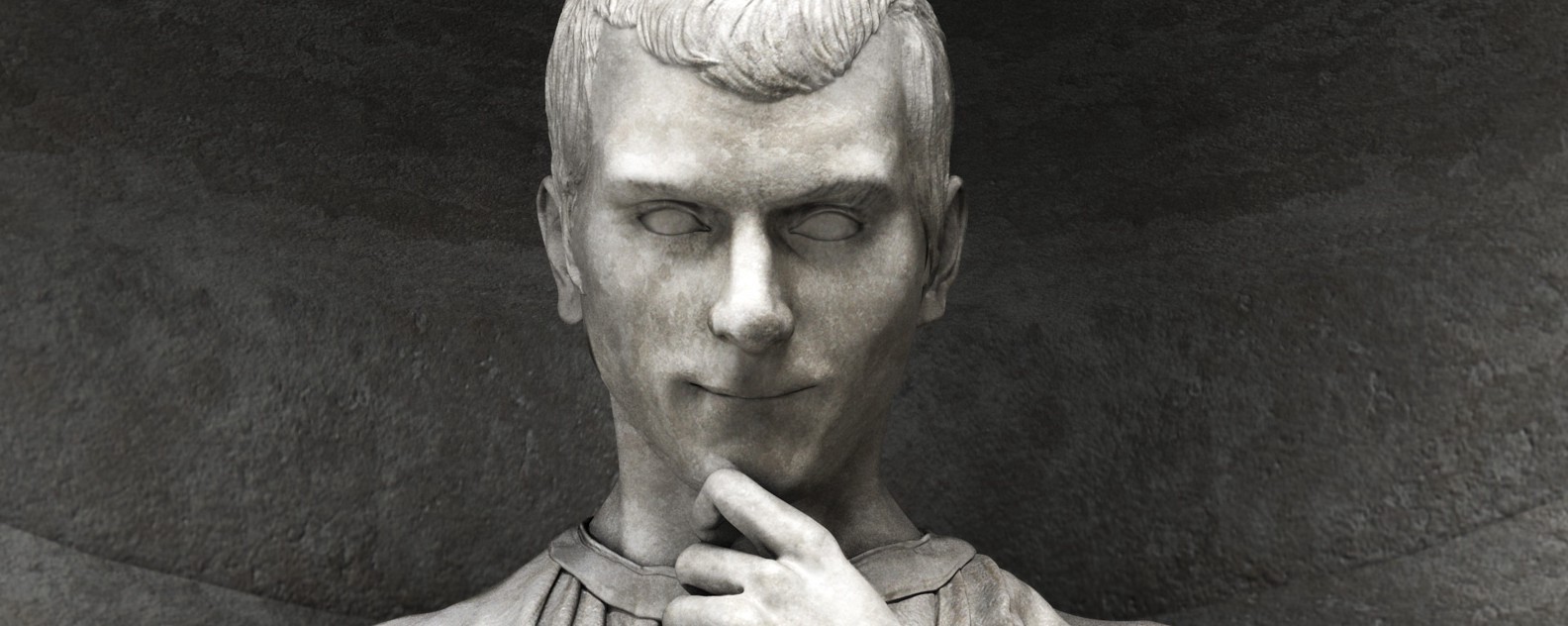
A statue of historian, politician, diplomat, philosopher, and writer, Niccolò Machiavelli is one of 28 statues of located along the colonnade of the Uffizi Gallery in Florence, Italy. It was created as part of a public subscription program began in 1834. I am unable to find the name of the sculptor.
Machivelli, says Ross King, wrote in The Prince, that the majority of men were “ungrateful, fickle, liars, and deceivers”. It’s a typical Florentine mysanthropy: Leonardo da Vinci noted in his journals the suspicion that not just individuals, but people in general are “nothing else than a passage for food and augmentors of excrement” — they passed through life leaving nothing behind but full latrines.
(This Fiorentine mysanthropy is broadly requited: Fiorentines are generally held to be the worst of Italians).
Machiavelli’s dictum is broadly in line with my own lifetime observation, not just on Fiorentines, but the race in general, that the five dominant traits of character of mankind are stupidity, laziness, dishonesty, venality and envy.
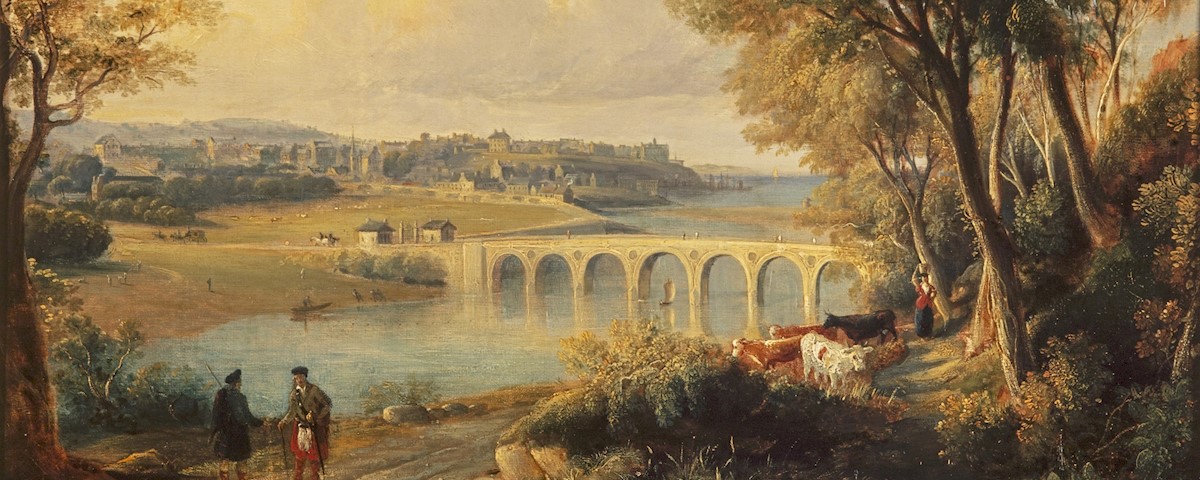
John Fleming; View of Banff with the Bridge over the River Deveron
Among other delightful stories told by Wasik and Murphy in their book Rabid is that of James Duff, the fourth Earl of Fife, a musty septuagenarian solitary figure, who, in the seclusion of his nearly abandoned Duff House, with only a handful of servants, lived a nocturnal life: he rose at 5 in the evening, returning to bed at 5 in the morning. One cannot conceive, wrote a visitor, why he should live in the midst of such fine gardens ornamented with beautiful walks, as environed his splendid residence, to enjoy it only for an hour or two in the evening of the day. But, the visitor allowed, Duff had one reasonable excuse: forty two years earlier, his wife, a legendary beauty, died after six years of marriage, leaving him no children. The cause was the canine madness: she was bitten by her own rabid lapdog.
Duff House is today a museum, one of the many I will never see. Which is too bad as it does have a few paintings worth seeing:
Pergola, by John Lavery
Alexander Nasmyth, A View of Tantallon Castle with the Bass Rock
Monet, Seascape
Bill Wasik, Monica Murphy, Rabid: A Cultural History of the World’s Most Diabolical Virus
Rabid: A Cultural History of the World’s Most Diabolical Virus is the sort of book I delight in: it is full of obscure facts and delightful anecodotes, beautifully told. And one of them, as I read last night, engaged my religious detector.
Hubertus was a knight in 7th century Belgium, who abandoned the world and moved into wilderness, to devote himself to the hunt. Hubertus was, in other words, a hermit. Like me, he perceived the illusory nature of the pursuits of social engagement — of career, ambition, social interaction. And perhaps he was also a sensitive person — perhaps social interaction grated on him as it grates on me? And he devoted himself to the hunt — the joyful, profoundly satisfying experience of flow — of doing well something that taxes all our abilities, not unlike my own work: after all, speculating in the stock market is a lot like going out to the wilderness to hunt. So Hubertus was a man by my heart. I pricked up my ears.
And there, in the wilderness, while pursuing a stag, Hubertus had a vision. I have seen this in art numerous times and always found it funny, a stag with a shining crucifix between his antlers, how dumb. Only now I understood that the vision of the cross is not the miracle; the cross is merely an artistic device, a symbol of something much more profound which happened, and which cannot be painted, which was that the stag… spoke. The stag spoke to Hubertus, saying: if you do not stop, you are damned.
In other words, this is another one of those dramatic events on the road to Damascus, given to some of us: a moment of a flash revelation, of sudden understanding; what the Japanese call satori, the awakening. Like me, Hubertus, had those, too.
And something else strikes me as profound: the vision of Hubertus is not one of a stag with a glowing crucifix between his antlers, but of God appearing to him in the form of a stag. To Christians it is nothing new to think of God in the form of a sacrificial animal; but this isn’t just a sacrificial animal, it is an animal a man chases and hunts. Like I once was, too, Hubertus was on a hunt for a deeper meaning of life.
The story then continues along familiar lines, with the conversion of Hubertus, his rise to the role of a miracle-making bishop, death, eventual canonization, the establishment of a shrine in his honor, the rise of the shrine to prominence and fame as a place where pilgrims were sometimes miraculously healed of rabies. All in all, it would be a disappointing story, of a hermit who escapes from the vanity of the world only to return to that very world; who seeks something profound and more satisfying in life than social success, only to experience a profound religious experience and, as a result of it, to reembrace social success, this time as a priest.
It would be a disappointing story if it weren’t for the way the authors tell it. They describe how in the healing ritual performed to cure those bitten by a rabid dog, the supplicants were chained to a wall, a cut was made in their forehead and a sacred thread implanted in the open wound. The pilgrim, say the authors, was made to shed blood so that — the dog’s sin could be forgiven.
And with that, my religious detector overheated and went into a long writhing paroxism.
The painting at the top is a fragment of a larger work by Wilhelm Carl Räuber (1849-1929), a brief glance at his other work suggests he tended to god-fearing kitch; and his main body of work, portraiture, wasn’t much to write home about. But this one painting works.
Even if I do prefer Pisanello. It is, shall we say, more fable-like.
Bill Wasik, Monica Murphy, Rabid: A Cultural History of the World’s Most Diabolical Virus




 Oltre Mare